Material guide
Closed Cell and Open Cell Spray Foam Insulation in Wausau
Open-cell and closed-cell are both sprayed from the same kind of rig and both called spray foam. Beyond that they're different materials, and picking the wrong one for a cold, damp spot is a mistake you can't fix without scraping it off.
The short version for a Wausau building: closed-cell anywhere it touches something cold or damp (rim joists, concrete, steel, roof decks), open-cell inside the warm part of the house where you want a full cavity for less money. Pick a spot to see the reasoning.
Closed Cell vs. Open Cell Spray Foam: Pick a Spot in the Building
Open-cell
- Density
- ~0.5 lb per cubic foot
- R per inch
- ~R-3.6
- Vapor
- Vapor-open (about 10 perms at 5 in.); needs a vapor retarder in exterior assemblies
- Below grade
- Not acceptable
- Feel
- Soft, spongy, trimmed flush
- Cost per inch
- Lower
Closed-cell
- Density
- ~2 lb per cubic foot
- R per inch
- ~R-6.1
- Vapor
- Under 1 perm at 2 in.: its own vapor retarder
- Below grade
- Preferred
- Feel
- Hard, rigid, sprayed in lifts
- Cost per inch
- Higher
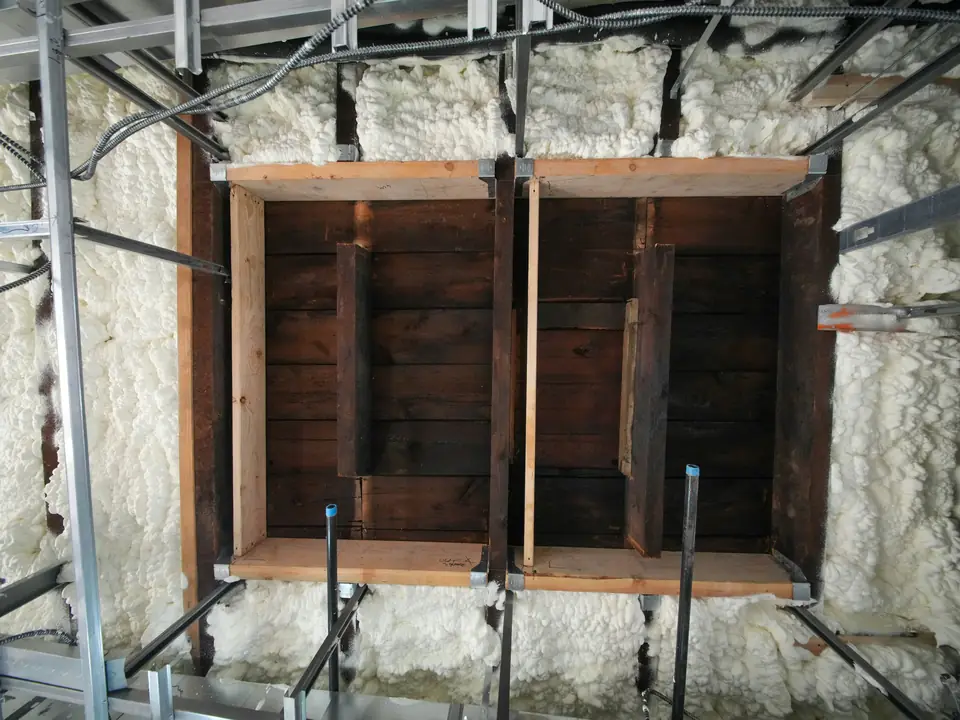
Rim joist: closed-cell. A thin wood band against outdoor air, with damp basement air on the inside. Closed-cell blocks the vapor and seals the gaps in one pass, and code lets it stay uncovered in the box sill.
Basement or crawl walls: closed-cell. Concrete stays cold and passes ground moisture. DOE's spray foam guide rates closed-cell "preferred" below grade and open-cell "not acceptable."
Pole barn steel: closed-cell. Steel is the coldest surface in the building. Foam that lets moisture through puts water right on it. Closed-cell bonds to the steel and keeps damp air off.
Roof deck, cathedral ceiling: closed-cell. In a Wausau winter the roof deck is cold for months. Closed-cell keeps indoor moisture off it and packs the most R into a shallow rafter. Open-cell can work only with a vapor retarder in front of it.
2x6 exterior wall: either. Either works. Open-cell fills the cavity for less money and needs a vapor retarder; closed-cell, alone or as the first 2 inches of a hybrid, is its own vapor control.
Interior wall or floor, for sound: open-cell. No heat or moisture to manage, just noise. Open-cell is soft, fills around everything and costs less per inch.
Density, R per inch, perm and below-grade ratings: DOE Building America / CARB, "Which Spray Foam Is Right For You?" Aged values; individual products vary.
Open Cell Spray Foam Insulation: Where It Belongs
Open-cell foam is sprayed thin, expands many times over and cures into a soft foam with broken cell walls, so air is stopped but water vapor passes. That makes it good at filling a cavity completely and sealing air leaks for less money per inch. It also means vapor travels through it toward whatever cold surface is behind.
In Marathon County, Wisconsin's code requires a vapor retarder on the warm side of insulation in frame walls, floors and ceilings. The exception is for foam rated 1.0 perm or less that supplies at least half the required R-value, and open-cell isn't, so an open-cell wall gets a vapor retarder in front of it. On a roof deck the same applies, and many builders here simply use closed-cell there instead.
Where it shines: interior walls and floors for sound, full 2x6 walls behind a vapor retarder and drywall, and large heated spaces where the cavity depth is generous.
Open Cell Spray Foam R-Value and the 2 Lb Closed Cell Hybrid Rule
Per inch, open-cell is about R-3.6 and 2-pound closed-cell about R-6.1. But the number that matters in a cold climate isn't only R-value; it's where the cold surface ends up and whether moist air can reach it.
That's the reason for the hybrid wall: a layer of closed-cell against the sheathing, then cheaper fill (cellulose or batts) for the rest of the cavity. The Department of Energy's guide says to use at least 1.5 inches of closed-cell in hybrid walls, and at least 2 inches above 6,000 heating degree days. Wausau's normal is 8,174. A 1-inch "flash" that works in a milder climate leaves the inside face of the foam cold enough to collect moisture here.
Try it in a 2x6 wall. The checks are the code's R-20 wall figure, DOE's 2-inch rule and Wisconsin's vapor-retarder exception (foam under 1 perm supplying half the required R).
Hybrid 2x6 wall
Closed-cell + celluloseWhole cavity:
- Meets the R-20 framed-wall minimum (SPS 322.31, Zone 1)
- At least 2 in. of closed-cell, per DOE above 6,000 heating degree days
- Foam supplies half the required R, so no separate vapor retarder (SPS 322.38)
Closed-cell R-6.1/in (DOE); cellulose R-3.5/in (midpoint of PNNL 3.2–3.8). Cavity only. A planning aid, not a design or a quote.
Closed Cell Spray Foam Insulation Contractors: Where Closed-Cell Earns Its Price
Closed-cell costs more per inch, so we use it where nothing else does the job as well:
- Rim joists and basement walls: cold wood and concrete, damp air, and code permission to leave rim foam exposed.
- Crawl space walls: below grade, where DOE rates it preferred.
- Pole barns and metal buildings: foam on the steel is what stops the dripping.
- Flat commercial roofs: roofing-grade closed-cell foam under a coating becomes the roof itself.
- Cathedral ceilings and roof decks: the most R in the least depth, with vapor control built in.
On an open attic floor, neither foam is the economical choice; blown-in fill over sealed plates is.
Closed Cell Spray Foam Installers Near Me: Lifts, Curing and Re-Entry
Every foam ships with a technical data sheet, and nearly every cure or odor problem traces back to one of its lines being ignored. Here's a closed-cell sheet, line by line. Tap a line to see what it means on your job.
Technical data: 2 lb closed-cell spray foam (typical)
Core density. What makes it "2-pound" foam. Open-cell runs about half a pound. Density is why closed-cell is rigid, blocks vapor and costs more per inch.
Aged R-value per inch. "Aged" matters: closed-cell loses a little R as its cells age, and the aged figure is the honest one to design with. Open-cell is about R-3.6. Compare bids on aged values.
Water vapor permeance. The line that decides vapor control. Wisconsin drops the separate vapor retarder where foam rated 1.0 perm or less supplies at least half the required R-value (SPS 322.38). Open-cell, at about 10 perms for 5 inches, doesn't qualify.
Mix ratio. The foam is two liquids that react as they leave the gun, and the rig has to keep them at the ratio and temperature on the sheet. Foam sprayed off-ratio can stay soft or sticky in spots, cure poorly and smell long after it should. A smell that hangs on past the re-occupancy time is a reason to call the installer back.
Maximum pass thickness. Closed-cell gives off heat as it cures, so it goes on in passes (lifts) no thicker than the sheet allows, each cooling before the next. Spraying too thick in one pass can overheat the middle, crack it or make it pull away from the framing. A 3-inch rim is usually more than one pass.
Surface and air temperature. Each product lists a minimum temperature for the framing and the air. Foam sprayed on a surface that's too cold can bond poorly and shrink back from the studs. In a Wausau January we heat the space and check the framing before spraying.
Re-occupancy time. How long people stay out while the foam cures and the space is ventilated. Ask for this number before the job starts, and plan pets and family around it.
Thermal or ignition barrier. Foam in living space gets a thermal barrier such as 1/2-inch drywall (SPS 321.11); the basement box sill and garage doors are exempt. Some attics and crawl spaces allow an ignition barrier instead, depending on the product's listing.
Density, R per inch and perm: DOE Building America spray foam guide. Lines marked "printed per product" vary by manufacturer; the real sheet for the foam being sprayed is the one that counts. Code: Wis. Admin. Code SPS 321.11 and 322.38.
We'll point you to the cheaper foam when it fits. If the wall is inside the heated house and has room, open-cell plus a vapor retarder does the job for less. We'd rather sell you the right foam than the expensive one.
For every job we take on as a Wausau spray foam insulation company, start at the homepage.
Closed-Cell and Open-Cell Questions
What is the R-value of open cell spray foam per inch?
About R-3.6 per inch, aged, in the Department of Energy's Building America spray foam guide. Closed-cell is about R-6.1 per inch. Individual products vary a little, and the product data sheet is the final word.
What does "2 lb" closed-cell foam mean?
Density: about 2 pounds per cubic foot of cured foam. Open-cell is about half a pound. The extra material is why closed-cell is firmer, blocks vapor and costs more per inch.
Is closed-cell or open-cell foam better for a Wisconsin attic?
For a vented attic with a floor, neither: seal and blow in fill. For foam on the roof deck, closed-cell is the safer choice in this climate, because the deck stays cold enough for long enough that vapor-open foam needs a separate vapor retarder to be safe.
Does spray foam need to be covered?
In a house, yes, with a thermal barrier such as 1/2-inch drywall (SPS 321.11), except in the basement box sill and on overhead garage doors. That applies to both open-cell and closed-cell.