Crawl spaces · additions · three-season rooms
Crawl Space Spray Foam Insulation in Wausau, WI
The crawl space is usually under the part of the house that was added later: the kitchen bump-out, the family room, the porch someone closed in. It's also usually the part with the cold floor and the pipes that freeze when it hits twenty below.
The fix that holds up here is to treat the crawl as part of the house: cover the ground, seal and insulate the walls and rim, and keep outside air out. Batts stapled under the floor are the common alternative, and they tend to be on the ground within a few winters.
Vented or Sealed? A Wausau Crawl Space in January and July
Vented crawl spaces were meant to dry out by trading air with outside. In this climate, outside air is the problem half the year in one direction and the other half in the other. Switch the season:
Vented crawl, insulation under the floor
January in the crawl
Wausau's average January low is 6.7°F and it drops below zero about 24 days a winter. Vent openings let that air straight in. Pipes in the crawl sit on the outside of the insulation, which is how they freeze, and every gap in the batts is a cold spot in the floor above.
July in the crawl
Warm, humid summer air comes in through the vents and meets cool soil, block and ductwork. It gives up moisture on them: damp wood, wet batts, a musty smell that rises into the house.
Sealed crawl, foamed walls
January in the crawl
The vents are closed, the rim and walls are foamed, and the crawl sits inside the insulated shell. The pipes and ducts are on the warm side and the floor above has no cold underside.
July in the crawl
No outside air means no summer moisture coming in. The sealed ground cover keeps soil moisture down, and the crawl is dried the way the code official accepts for that house.
Spray Foam Crawl Space Walls vs. Insulating the Floor Above
Wisconsin's dwelling code gives you both options for Marathon County. Insulate the floor over the crawl to R-30 (or fill the joist cavity to at least R-19), or insulate the crawl space walls to R-10 continuous or R-13 in a cavity.
The wall option (the same idea as insulating any other wall, just below the floor) uses less material (a crawl's walls usually have less area than its ceiling), keeps pipes and ducts inside, and doesn't depend on batts staying up. Closed-cell foam is the material for it: the Department of Energy's spray foam guide rates it preferred below grade, and at 2 inches it's under 1 perm, so it's its own vapor control. At R-6.1 per inch, about 2 inches clears R-10.
The floor option still makes sense over a crawl that's too wet or too tight to seal, or under a three-season room that's not heated at all. Then the floor gets dense insulation with real support, and the pipes get moved or protected.
Wall foam in a crawl generally needs a covering: Wisconsin's code exempts only the box sill from the thermal-barrier rule. We settle what's accepted for your crawl before we start.
Crawl Space Insulation and Vapor Barrier: Start With the Ground
Whatever is on the floor of the crawl decides the first step. Pick yours:
Bare dirt
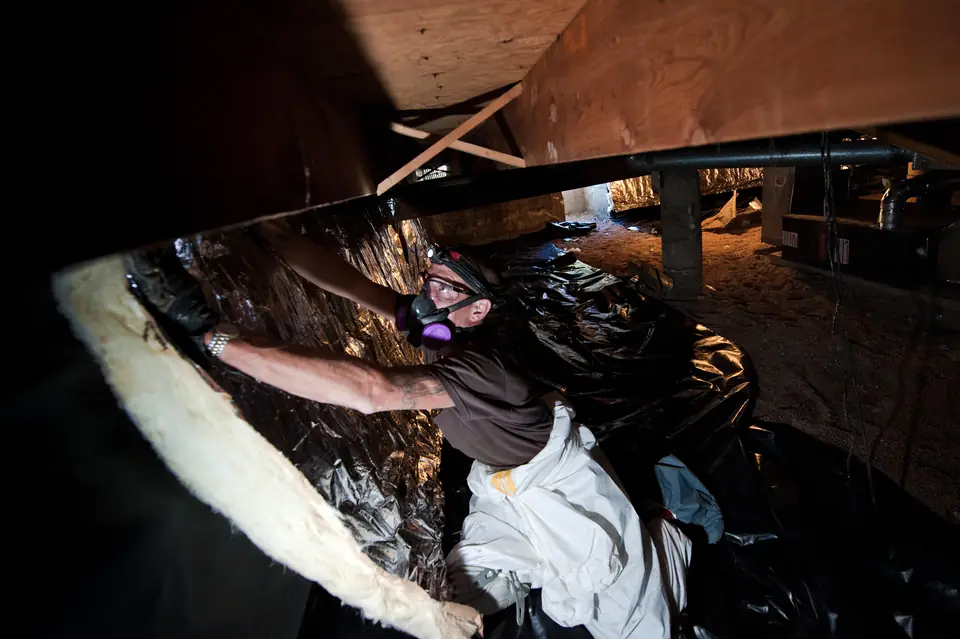
Rake out debris and sharp rock, then lay a heavy ground cover with the seams overlapped and taped and the edges run up the walls and sealed. That sheet is the vapor barrier; the wall foam goes over its top edge.
Torn or loose old plastic
Usually comes out. Old thin poly has gaps at every seam and wall, so it slows ground moisture but doesn't stop it. If it's intact we can sometimes lay new over it.
Thin concrete over the ground
Better than dirt, but concrete passes ground moisture. It gets cleaned, and either a ground cover over it or a sealed edge, depending on condition.
Standing water
Stop here. Water in the crawl is a drainage job (grading, gutters, a sump) before it's an insulation job. We'll tell you that rather than foam over a wet space.
Radon is worth a thought too. Wisconsin's radon program has pointed to the geology around Marathon County as a reason for more high test results there, and a sealed ground cover is the base a mitigation system ties into if a test calls for one.
Crawl Space Insulation Contractors: What a Crawl Job Includes
- Look first. Height, access, moisture, wiring, ducts, plumbing, and whether old insulation or debris has to come out.
- Clean out. Fallen batts, debris and old plastic come out.
- Ground cover. Sealed at the seams and walls.
- Rim and walls. Closed-cell foam on the rim joist and down the walls to the ground cover, sealing the vents and penetrations as part of it.
- Cover and finish. Covering over wall foam as required, then a walk-through of the whole crawl with you, on camera if you'd rather not crawl.
If the crawl connects to a basement, the basement and rim joist work usually happens in the same visit. Houses with an addition over a crawl also tend to have a low, hard-to-reach attic over that addition; that's covered under attic insulation.
Crawl Space Problems Under Wausau Additions: Signs, Causes and Fixes
Most calls about a crawl space start with one of these. Open the one you're seeing.
Crawl space symptoms and what causes them
Pipes that freeze in a cold snapWinter
- Why it happens
- The pipes run below the floor insulation, on the cold side, with vents letting outside air straight at them. Wausau averages 24 days a year below zero, and the record is -40°F.
- The fix
- Insulate the walls and rim and seal the vents, so the pipes end up inside the insulated shell. Heat tape is a patch, not a fix.
A floor that's cold underfoot all winterWinter
- Why it happens
- Batts in the joists with gaps at the rim, or batts that have slumped away from the subfloor. Cold air washes through the gap and under the floor.
- The fix
- Air seal the rim joist first, then either insulate the walls or, where the crawl can't be sealed, insulate the floor with material that stays in contact with it.
A musty smell in the house in summerSummer
- Why it happens
- Humid outdoor air comes in through the vents and gives up its moisture on the cool soil, block and ductwork. Bare dirt adds more.
- The fix
- A sealed ground cover and closed vents. Once outside air stops coming in, the summer moisture source goes away.
Batts hanging down or lying on the groundAny time
- Why it happens
- Batts absorb moisture from damp crawl air, get heavy, and pull away from whatever was holding them up. Mice help.
- The fix
- They come out. Replacing them with more batts in the same damp crawl tends to repeat the result, so the walls usually become the target.
Frost or dark, damp wood on the rim joistWinter
- Why it happens
- Damp crawl air reaching the coldest wood in the crawl and condensing on it, the same thing that happens on an uninsulated basement rim.
- The fix
- Closed-cell foam on the rim: it seals the gaps and keeps damp air off the cold wood. Dark or soft wood gets looked at before it's covered.
Droppings and nestsAny time
- Why it happens
- Vent openings and gaps at the sill let mice in, and old batts give them bedding.
- The fix
- Clean out, then close the openings and seal the rim. To be straight about it: foam isn't pest-proof, and mice can chew it, so sealing the entry points is what matters.
Climate figures: NWS Green Bay, Wausau climate records (1991–2020 normals). Fixes are typical starting points, settled on site.
Crawl Space Insulation Companies: When We'd Tell You No
Not every crawl should be sealed, and not every crawl can be. We'll say so if the access is too tight to work safely, if there's standing water or active leaks, or if the room above is an unheated porch that doesn't need it. In those cases we'll explain what would have to change first, or recommend insulating the floor and moving on.
For the bigger picture of what we do as a spray foam insulation contractor around Wausau, start at the homepage.
Crawl Space Questions We Hear
Should I close my crawl space vents?
Only as part of sealing the whole crawl: ground cover down, walls and rim insulated, and the space conditioned or dried the way your code official accepts. Closing vents over bare dirt just traps the soil moisture.
What is the best insulation for a crawl space with a dirt floor?
Cover the dirt first with a sealed ground cover, then closed-cell foam or sealed rigid board on the walls and rim. Batts in the floor above a dirt crawl are the worst combination: damp air, sagging insulation and cold pipes.
Can the crawl space foam be left bare?
Wisconsin's dwelling code exempts the box sill from the thermal barrier rule, but it doesn't list crawl space walls. So we plan a covering for wall foam and confirm with the inspector what is accepted for that crawl before we start.
Can you insulate a crawl space that is only 18 inches high?
Sometimes. We need to be able to get to every wall and the rim safely. If we can't, we'll say so; insulating the floor from above during a remodel may be the realistic option.