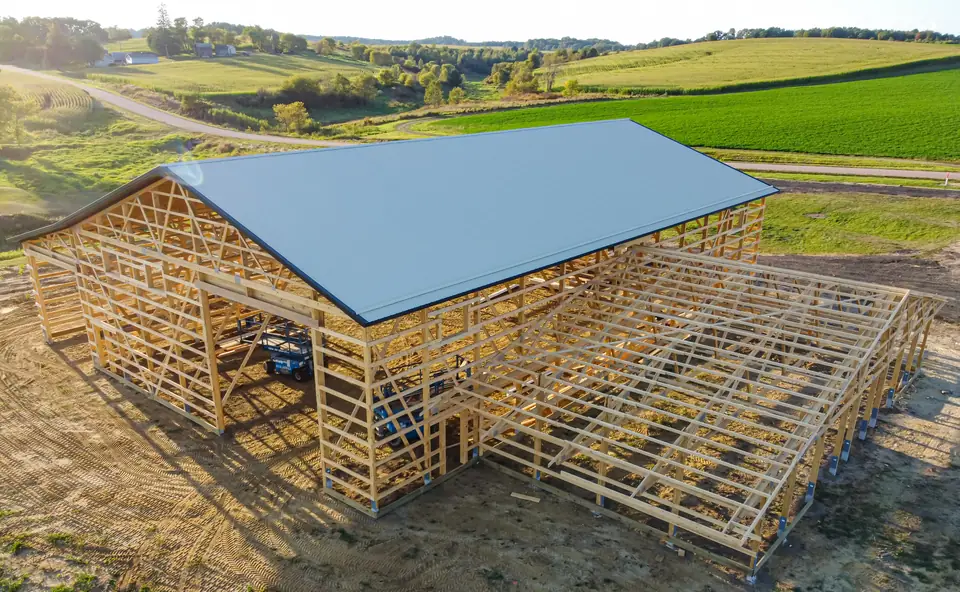
Pole barns · machine sheds · shops · barndominiums
Pole Barn Spray Foam Insulation in Wausau, WI
A cold morning in a steel building and it's raining indoors: water beading on the underside of the roof and dripping on the tractor, the hay or the truck you just washed. That's condensation, and it's the reason most people call us about a pole barn before they ever think about heat.
Why Pole Barn Steel Drips: Condensation Under a Metal Roof
Air holds water vapor. Cool it to its dew point and the vapor turns to liquid on whatever is coldest. In a steel building, that's the steel: a sheet of metal with almost no insulating value between your air and a Wausau night that averages 6.7°F in January. On a clear night a roof can get colder than the air, too, because it radiates heat to the sky.
Moisture comes from more places than people expect: livestock, wet hay, a newly poured concrete floor, snow melting off equipment, and unvented propane or kerosene heaters, which add water vapor as they burn.
The fix is to keep that air away from the cold steel, or keep the surface it touches warm. Closed-cell foam sprayed on the steel does both: it bonds to the metal so air can't get behind it, and its inside face stays near room temperature.
Will your roof drip? Try your building
A physics sketch, not a designDew point of the inside air: · Inside surface of the roof:
Dew point by the Magnus formula. Surface temperature from a simple series-resistance estimate: inside air film R-0.68, outside film R-0.17 (ASHRAE), closed-cell foam R-6.1 per inch (DOE Building America); the steel itself adds almost nothing. Real roofs on clear nights run colder than the outside air.
Spray Foam Insulation for Metal Buildings: How Thick, and Where
Unheated machine sheds and cold storage. The goal is a dry roof, not a warm building. A layer of closed-cell on the roof steel, sometimes the upper walls, stops the drip over equipment and stored feed. It also seals every fastener and lap from inside.
Heated shops. Now heat matters as well as condensation. Walls and roof get more foam, and the overhead doors, slab edge and the gap at the bottom of the wall steel get attention, because that's where the heat leaves. The calculator above shows why a warm, humid shop needs more foam than a cold shed to stay dry.
Framed interior walls. A shop lined with stud walls is insulated like any framed wall; see wall insulation.
Where it goes. Foam is sprayed directly on the steel, between the purlins and girts. Purlins and posts can be left bare or lightly coated. Doors, windows and the ridge vent (if there is one) are masked.
Thinking about foam on the outside of an old steel roof instead? That's spray foam roofing, and it's worth comparing if the roof itself leaks.
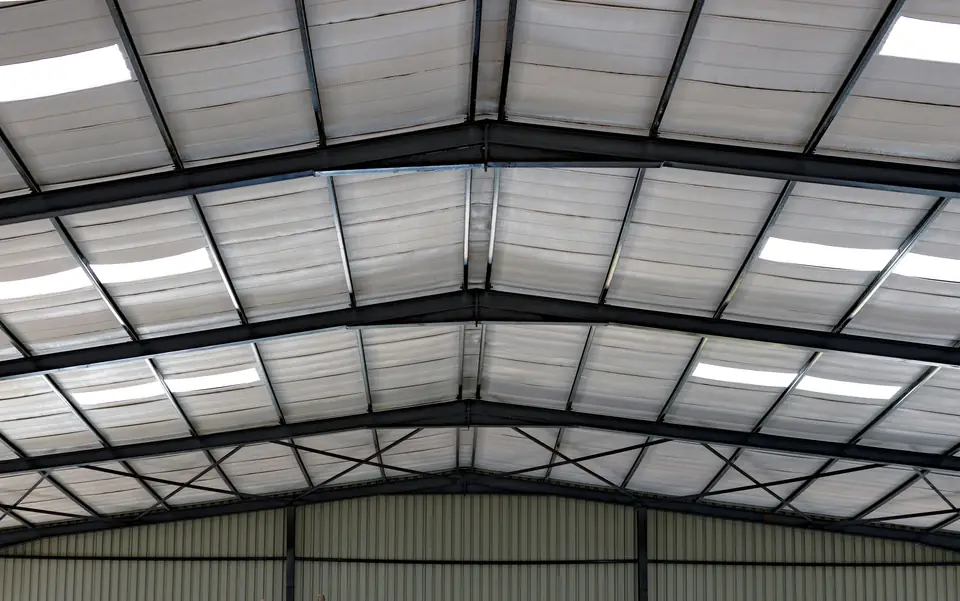
Metal Building Insulation Options: Rolls, Bubble Foil, Board and Foam
Every option works in the right building at the right time. Tap a row for when it fits.
| Option | Seals laps and fasteners | Keeps damp air off the steel | Easy on an existing building |
|---|---|---|---|
| Faced fiberglass rolls (blanket) | No | Only if the facing is continuous and taped | No: goes in as the steel goes on |
| Reflective bubble or foil | No | Partly, with taped seams | No: goes in as the steel goes on |
| Rigid foam board liner | No | Yes, if every joint is sealed | With framing |
| Closed-cell spray foam | Yes | Yes | Yes |
| Open-cell spray foam | Yes | No: vapor passes through to the steel | Yes |
Faced rolls: the cheapest way to insulate a new metal building, rolled out over the purlins as the steel goes on. Retrofitting it into a finished building is awkward, and a torn or sagging facing lets moist air reach the steel.
Bubble foil: common in new pole barns as a condensation layer. On its own it adds little insulation, and every untaped seam is a place for damp air to reach the steel.
Rigid board: good for a finished shop interior with a liner over it. Every joint must be sealed or air goes around it.
Closed-cell spray foam: the retrofit answer. It goes onto the steel of a building that's already standing, seals the laps and fasteners, and keeps damp air off the metal. It costs more than rolls up front.
Open-cell spray foam: not for steel. It stops air but lets vapor through, so moisture reaches the cold metal and can collect behind the foam. We don't use it there.
Why closed-cell and not open-cell on steel is covered in more depth on closed and open cell spray foam.
Steel Building Insulation for Heated Shops and Barndominiums
A barndominium is a house in a steel shell, and the rules follow the use, not the siding. Live in it and Wisconsin's Uniform Dwelling Code applies: in Marathon County that means R-49 at the ceiling and R-20 (or R-13 plus R-5) in framed walls, a vapor retarder or vapor-tight foam on the warm side, and a thermal barrier such as 1/2-inch drywall over any foam in the living space.
Closed-cell foam on the steel works well in a barndominium because it handles the condensation, air sealing and vapor control in one layer, leaving the framed interior walls for wiring and finish. Ceilings are often a flat drywall ceiling with blown fill above it, which is cheaper than foaming the whole roof.
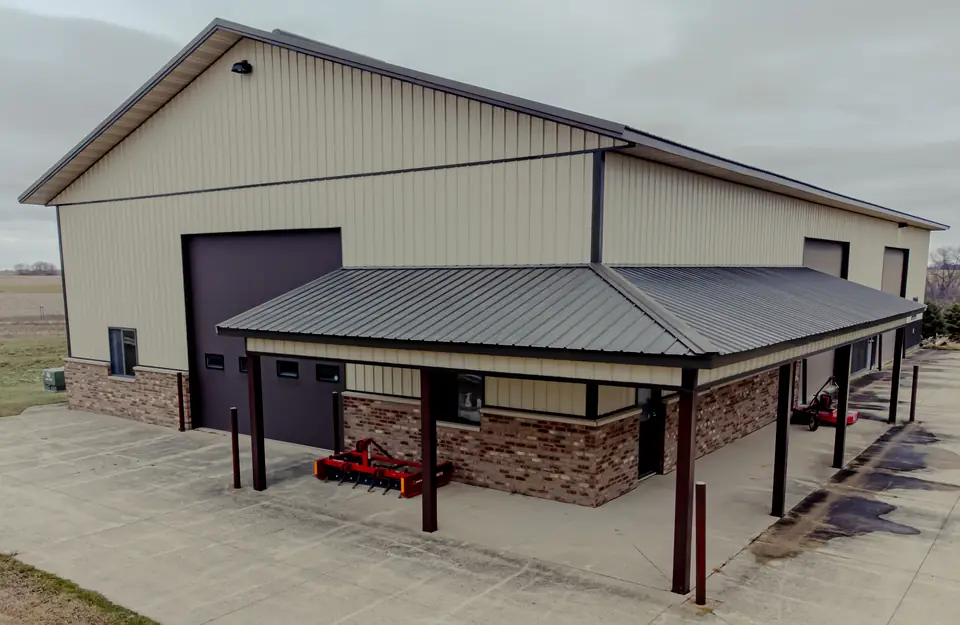
Same steel, five different jobs
Pick how the building is usedCold machine shed or storage barn
- Code
- Exempt from the commercial code if used only for farming (SPS 361.02).
- Where the moisture comes from
- Melting snow off equipment, the ground, and humid summer air meeting steel cooled overnight.
- Insulation approach
- A layer of closed-cell on the roof steel, sometimes the upper walls. The goal is a dry roof, not a warm building.
Livestock barn
- Code
- Exempt if used only for farming.
- Where the moisture comes from
- The animals themselves, plus bedding and wet feed. Far more moisture than any shop.
- Insulation approach
- Foam stops the steel dripping, but ventilation has to carry the moisture out. Fans and air inlets come first; foam doesn't replace them.
Heated farm shop
- Code
- Exempt if used only for farming, even when heated.
- Where the moisture comes from
- Snow and mud melting off equipment, and unvented propane or kerosene heaters, which add water vapor as they burn.
- Insulation approach
- Foam on the roof and walls, plus attention to the overhead doors, the slab edge and the bottom of the wall steel. Welding and grinding near exposed foam mean planning a covering over it.
Shop for a business
- Code
- Wisconsin's commercial code, the 2021 IECC since November 1, 2025, sets the insulation minimums.
- Where the moisture comes from
- Same sources as any heated shop, plus whatever the business does: wash bays and paint booths add a lot.
- Insulation approach
- Foam sized to the commercial code minimums or past them, and a permit through the municipality or Marathon County before work starts.
Barndominium
- Code
- Wisconsin's Uniform Dwelling Code: the house rules, not the barn rules.
- Where the moisture comes from
- Everyday living: cooking, showers, people breathing. A tight steel shell holds it in.
- Insulation approach
- Closed-cell on the steel for condensation and vapor control, framed interior walls, drywall over any foam in the living space, and often a flat ceiling with blown fill above it.
Code: Wis. Admin. Code SPS 361.02 (farm exemption); commercial energy code 2021 IECC, effective 11/1/2025 (U.S. DOE energy code status for Wisconsin); Uniform Dwelling Code for dwellings. Confirm the permit path for your building before work starts.
Spray Foam Pole Barn Work Around Marathon County Farms
Marathon County has 2,059 farms and ranks third in Wisconsin for milk sales (USDA 2022 Census of Agriculture), so a lot of the steel buildings around Wausau hold heifers, feed, equipment or a farm shop rather than a hobby truck. That changes the job:
- Animals add moisture. A barn with livestock needs ventilation as well as insulation. Foam stops the steel from dripping; it doesn't replace fans and air inlets.
- Equipment has to move. Plan the job between field seasons, and clear the bays we're spraying.
- Farm-only buildings are exempt from Wisconsin's commercial building code, which keeps the paperwork light. You still want it done right.
When foam isn't the answer: if a cold storage shed only drips a few mornings a year and nothing under it is harmed, a fan and better venting may be all you need. We'll tell you that rather than sell you foam.
For houses, attics and everything else we do as a spray foam insulation contractor around Wausau, see the homepage.
Pole Barn and Steel Building Questions
How much spray foam does a pole barn roof need to stop dripping?
Enough to keep the inside face of the foam above the dew point of the air in the building on the coldest nights. For an unheated machine shed that can be a thin layer; for a heated, humid shop it is more. Play with the calculator above, then we size it to your building and how you use it.
Can you spray foam a pole barn that already has the steel on?
Yes. That is the most common job: foam sprayed directly on the underside of the steel roof and walls of an existing building, between the purlins and girts. If old blanket or bubble insulation is hanging there, it comes down first.
Does exposed spray foam in a shop need a covering?
Exposed foam burns, so in a shop where you weld, grind or run a wood stove, plan on a thermal or ignition barrier over it and ask what the code requires for your building. In a barndominium or any living space, Wisconsin's dwelling code requires a thermal barrier such as 1/2-inch drywall.
Do farm buildings need to meet the energy code?
Under Wisconsin's commercial code (SPS 361.02), buildings on a farm used exclusively for farming purposes are exempt. A shop used for a non-farm business, or a barndominium someone lives in, is a different story.