Open studs · finished walls · garages · block
Spray Foam Wall Insulation in Wausau, WI
The right way to insulate a wall depends on one question more than anything: is it open or closed? Bare studs in an addition get sprayed. A plastered wall in a 1920s house on the east side gets filled through holes. A block garage gets something else entirely.
Wisconsin's dwelling code puts the target for a framed wall in Marathon County at R-20, or R-13 in the cavity plus R-5 of insulated sheathing outside. A 2x4 wall can't reach R-20 with fluffy insulation alone, which is why the method matters more here than in milder places.
Which Wall Insulation Fits Your Wall?
Bare studs: remodel, addition, new build
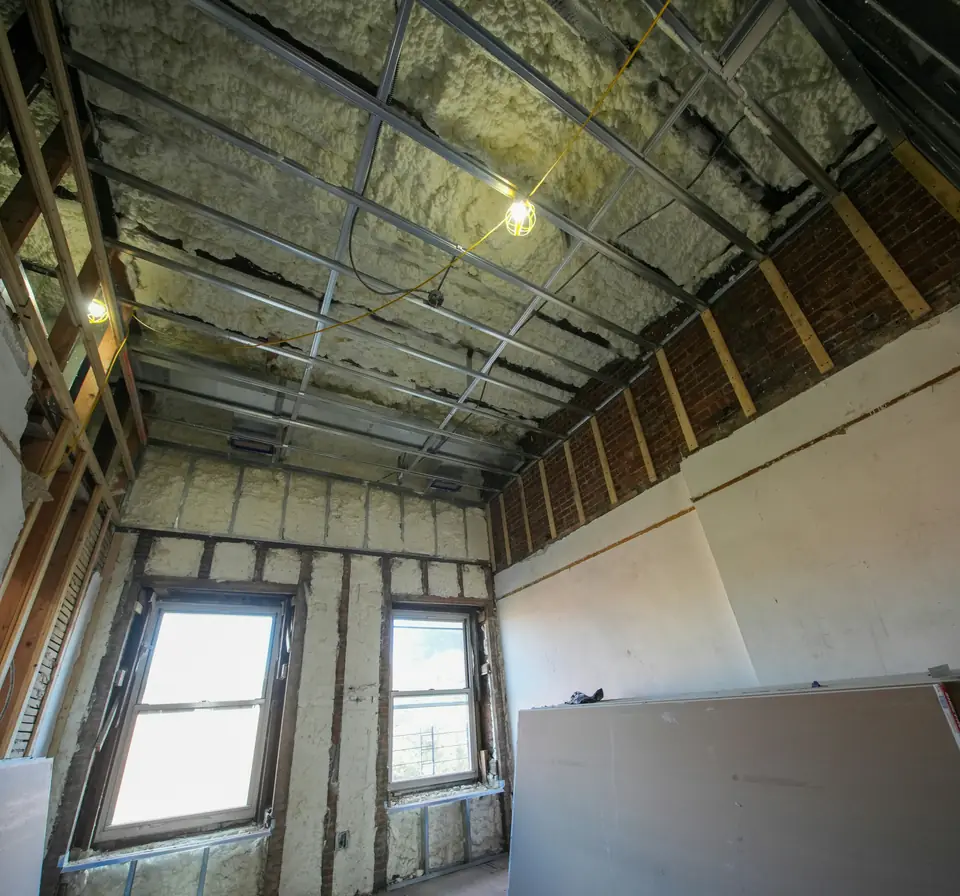
Spray foam or batts. Closed-cell foam air-seals the studs and plates as it insulates and needs no separate vapor retarder when it supplies at least half the R-value. Open-cell fills the cavity for less but needs one. Either way the foam gets drywall over it.
Finished plaster or drywall, empty cavities
Dense-packed cellulose or injection foam through 1- to 2-inch holes, one or two per stud bay, plugged and patched afterward. Every bay gets probed for blocking, wiring and old fill first.
Re-siding: foam board outside
The best moment to fix a wall. Fill the cavities from outside, then add rigid foam sheathing under the new siding. That's the code's R-13 + R-5 recipe, and the outer layer covers the studs, which are a thermal bridge in every wall.
Garage walls
Unheated garage: insulate only the wall shared with the house, and seal it. Heated garage or shop: all exterior walls, plus the ceiling, plus a plan for the overhead door. Foam in a garage needs a thermal barrier like drywall, except on the overhead door itself.
Concrete block or cinder block
Hollow block conducts heat through its webs, so filling the cores alone does little. Closed-cell foam or rigid board on the inside face, then studs and drywall, insulates the whole face and keeps damp air off the cold block. Below grade, see basement walls.
In-Wall Insulation R-Values: What Fits in a 2x4 or a 2x6
Same wall, different fill. Pick the stud size. The dashed line is the R-20 code figure for a framed wall in Marathon County.
| Fill | 2x4 wall | 2x6 wall |
|---|---|---|
| Cellulose, dense-packed | R-12 | R-19 |
| Open-cell foam, full cavity | R-13 | R-20 |
| 2 in. closed-cell + cellulose | R-17 | R-24 |
| Closed-cell foam, full cavity | R-21 | R-34 |
Per-inch values: closed-cell R-6.1 and open-cell R-3.6 (DOE Building America spray foam guide), cellulose R-3.5 (midpoint of PNNL's 3.2–3.8). Cavity values only; studs conduct more heat than the fill, which is why sheathing on the outside helps.
Two things jump out. Full-cavity closed-cell in a 2x6 is far past what a wall needs, so we don't sell it that way. And the 2 inches of closed-cell in the hybrid row isn't arbitrary: the Department of Energy's guide calls for at least 2 inches in hybrid walls where heating degree days top 6,000. Wausau's are 8,174.
Spray Foam Existing Walls: What Works Without Tearing Them Out
Ordinary spray foam expands fast and needs an open cavity, so it can't go into a finished wall. For closed walls there are two real options:
- Dense-packed cellulose. Blown through a tube at high density so it fills the bay and won't settle. It's the workhorse for old houses and usually the cheaper of the two. More on blown-in insulation.
- Injection foam. A slow-rise foam made for closed cavities, pumped in through holes. It also blocks air, but it costs more, and like any fill it shouldn't bury live knob-and-tube wiring before an electrician has looked at it.
Either way we drill, fill and plug from whichever side does less damage. With wood or vinyl siding that's usually outside; with plaster we'd rather not patch inside unless the walls are being painted anyway.
Adding Insulation to Existing Walls in Wausau's Older Houses
The year a house was built predicts what's inside its walls better than anything else we can see from the street. Wausau's 18,718 homes split into four roughly equal eras. Slide to yours.
-
Built before 1940: balloon frames and empty bays
4,494 Wausau homes, about 24%
What's usually in the wall: nothing, or old wood shavings and newspaper. Plaster on wood lath. Often balloon framing, where the stud bay runs from the basement to the attic. Sometimes knob-and-tube wiring.
What we'd do: block each bay top and bottom, check the wiring, then dense-pack cellulose, usually from outside. This is where wall work pays back fastest.
-
Built 1940 to 1959: plates at every floor, thin or no fill
4,339 Wausau homes, about 23%
What's usually in the wall: 2x4 studs on platform framing, so each floor's bays are closed at the top and bottom. Plaster or early drywall. Little or no insulation is common.
What we'd do: probe a few bays, then dense-pack or injection foam through holes. No blocking needed, so it goes faster than a balloon frame.
-
Built 1960 to 1979: 2x4 walls with thin batts
4,134 Wausau homes, about 22%
What's usually in the wall: drywall and 2x4 studs with fiberglass batts, often thin by today's standard and sometimes slumped or cut short around boxes.
What we'd do: usually leave the cavities alone. Filling a bay that already has a batt in it gains little. The time to fix these walls is when the siding comes off: foam sheathing outside, the code's R-13 + R-5 recipe.
-
Built 1980 or later: insulated under Wisconsin's dwelling code
5,751 Wausau homes, about 31%
What's usually in the wall: insulation to the code of its day. Wisconsin's Uniform Dwelling Code covers homes built on or after June 1, 1980, and newer ones are often 2x6.
What we'd do: leave the walls and look up and down instead. In these houses the attic air sealing and the rim joist usually pay back first.
Counts: U.S. Census ACS 2020–2024 5-year, table B25034, City of Wausau. UDC scope: Wisconsin DSPS. Typical contents are what's common for each era, not a promise about your wall; we probe before we fill.
Three things in the oldest of that stock change how we insulate a wall:
Balloon framing
Many older houses have studs that run from the sill all the way to the roof, with no plate at the second floor. The wall cavity is an open flue from basement to attic. Blowing fill into it without blocking the top and bottom first wastes material and leaves the air path open.
Knob-and-tube wiring in the walls
If the house still has live knob-and-tube wiring in the walls, have an electrician look at it before anyone buries it in insulation. We check bays with a scope or a test hole before filling.
Plaster and lath walls
It's tough and it holds the fill well, but it cracks if someone drills carelessly. Outside access is usually cleaner.
Plan on surprises. In a pre-1940 wall we find old newspaper fill, mouse nests and abandoned gas lines. Keep 10 to 15% of the wall budget in reserve; we stop and show you before going around anything.
Wall Insulation Installation in Open Studs: Vapor Control and Covering
- Seal before filling. Gaps at the bottom plate, around window rough openings and at wire holes get sealed, unless closed-cell foam is going to do that as it goes on.
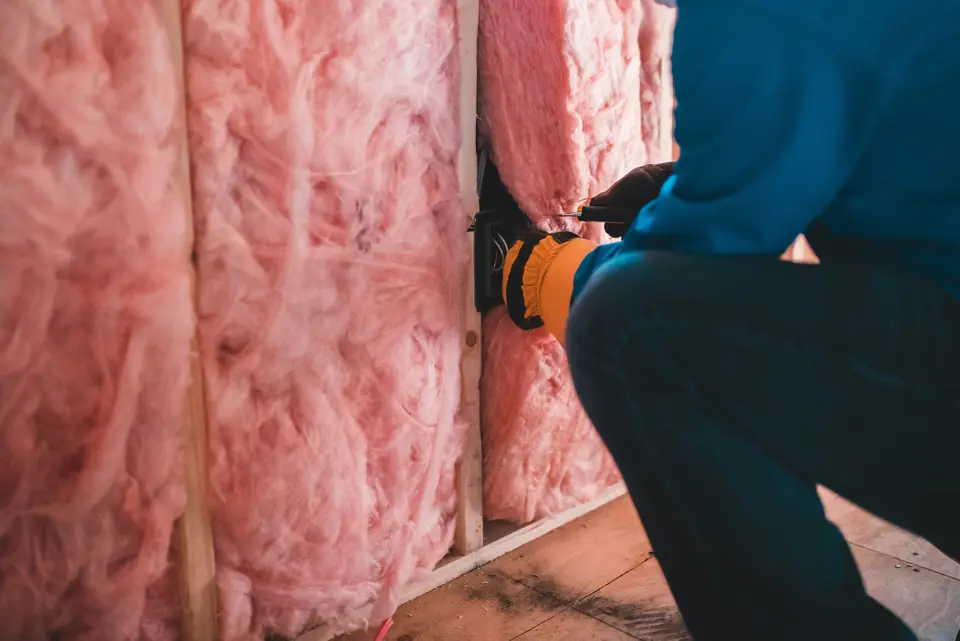
- Fill completely. Batts need to be cut around every box and wire, not stuffed over them. Foam fills around them on its own.
- Vapor retarder, if needed. Code calls for it on the warm side of fiberglass, cellulose and open-cell walls. Closed-cell walls with at least half their required R from foam under 1 perm don't need it.
- Thermal barrier. Foam in living space is covered with 1/2-inch drywall or an equivalent before anyone lives with it (SPS 321.11).
Garage Walls, Bathroom Walls and Concrete Block
Garage walls. The wall between an attached garage and the house is the one that matters most, and it's usually the leakiest: outlets, a door and a rim joist above. Foam there gets drywall over it. For a heated garage, the ceiling and the overhead door matter as much as the walls.
Bathroom walls. An exterior bathroom wall full of plumbing is where pipes freeze in a cold snap. We fill behind the pipes, not in front of them, so the pipes stay on the warm side.
Block walls. Above grade on a garage or shop, insulate the inside face and frame over it. Below grade, it's foundation work, covered with basement insulation. If you're comparing foams for any of this, the trade-offs are on closed vs open cell spray foam.
How walls fit with the attic, rim joist and crawl space, and what to ask any spray foam insulation company in Wausau before you hire, is laid out on our homepage.
Questions About Insulating Walls
Can you spray foam into a wall without taking the drywall off?
Not the expanding spray foam used in open studs; it needs an open cavity to spray into. Closed walls get filled through small holes with dense-packed cellulose or a slow-rise injection foam, then the holes are patched. On an older house we often do it from outside while the siding is off.
Do insulated exterior walls need a plastic vapor barrier in Wausau?
Wisconsin's code wants a vapor retarder on the warm-in-winter side of frame-wall insulation. Closed-cell foam that supplies at least half of the required R-value is exempt from that, because the foam itself is under 1 perm. Fiberglass, cellulose and open-cell walls still get the vapor retarder.
Is it worth insulating interior walls?
For heat, no. For sound, sometimes: open-cell foam or batts in a bathroom or bedroom wall cut noise between rooms. We will tell you which one you are buying.
What is the best insulation for outside walls in an old house?
Whatever fills the cavity completely without trapping moisture. In balloon-framed houses we block the cavity top and bottom first, then dense-pack. If the siding is coming off anyway, adding rigid foam sheathing outside is the best upgrade there is, because it covers the studs too.