Cost guide · national published ranges · Wausau job conditions
Spray Foam Insulation Cost in Wausau, WI
We don't publish prices, and this page won't sneak one in. What it does give you: the national ranges that published cost guides print, with their dates, what pushes a Wausau job toward the top or bottom of them, and a way to check that two bids describe the same job before you compare totals.
Every dollar figure below is a national range from a named guide (Fixr, HomeGuide). None of them is a Wausau quote or our price.
How an insulation bid is built
- Areasquare feet of surface being insulated, not floor area
- × inchesset by the R-value target; for foam, area × inches = board feet
- × materialclosed-cell, open-cell, cellulose or fiberglass
- + accessattic clearance, finished ceilings, a shop full of equipment
- + tear-outold insulation vacuumed out and hauled away
- + air sealingthe slow, cramped part, and the part cheap bids skip
- + coveringdrywall over foam in living space
Spray Foam Insulation Cost per Square Foot, per Board Foot and per Job
Cost guides and bids use three different units, and mixing them up is how people end up comparing a 2-inch job with a 6-inch one.
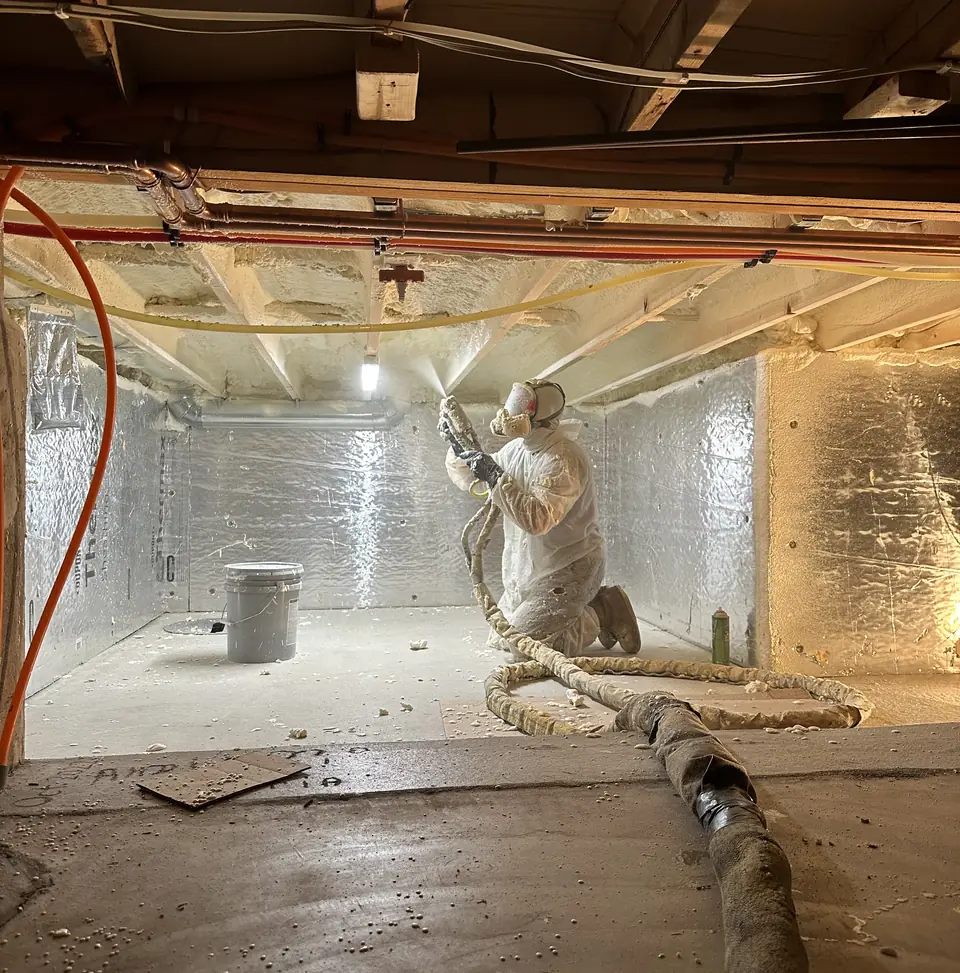
- Per board foot. One square foot, one inch thick. Foam is sold and sprayed by the board foot, Fixr's guide explains, so this is the honest unit: it can't hide the depth.
- Per square foot. Board feet folded into one area number. "Spray foam insulation per sq ft" only means something with the inches attached, and HomeGuide's per-square-foot figures count the surface sprayed, not the floor area of the house.
- Per job. Whole attics, garages and houses. These include setup, access and minimum charges, which is why a small job costs more per square foot.
| What | Published national range | Source (updated) |
|---|---|---|
| Spray foam, existing home | $3.15 to $7.50 per sq ft, installed | Fixr (Jan 31, 2025) |
| Spray foam, new construction | $2.75 to $6.50 per sq ft, installed | Fixr (Jan 31, 2025) |
| Spray foam, any job (surface sprayed) | $1.50 to $5.00 per sq ft, installed | HomeGuide (Dec 1, 2025) |
| Open-cell foam | $1.50 to $3.50 per sq ft installed; material alone $0.44 to $0.65 per board foot | HomeGuide (Dec 1, 2025); Fixr (Jan 31, 2025) |
| Closed-cell foam | $3.00 to $5.00 per sq ft installed; material alone $1.00 to $1.50 per board foot | HomeGuide (Dec 1, 2025); Fixr (Jan 31, 2025) |
| Rim joists, spray foam | $2,000 to $2,500 per job | HomeGuide (Dec 1, 2025) |
| Whole existing house, spray foam | $10,000 to $30,000; about $20,000 for 2,000 sq ft at roughly 6 inches of mixed foam | Fixr (Jan 31, 2025) |
| Whole house, spray foam | $8,000 to $20,000 | HomeGuide (Dec 1, 2025) |
| Small-job minimum fee | $1,000 to $2,000 or more at most spray foam companies | HomeGuide (Dec 1, 2025) |
National averages, not Wausau prices and not ours. Fixr.com, "Spray Foam Insulation Cost"; HomeGuide, "Spray Foam Insulation Cost". The two guides disagree by a wide margin, which tells you how much depth, access and region move the number.
Spray Foam Cost per Inch: Open-Cell Against Closed-Cell
In Fixr's material ranges, closed-cell runs about 2.3 times open-cell per board foot at both the low and the high end. Each inch of it also does more: about R-6.1 against R-3.6 for open-cell (Department of Energy figures), and 2 inches of it stops vapor. So at the same R-value you buy fewer board feet of the dearer foam, and the gap per R narrows. It doesn't close.
Where closed-cell is worth paying for: rim joists, concrete, pole barn steel, the eaves and shallow rafter bays where depth runs out. Where it isn't: an open attic floor or an interior wall for sound. We'd rather tell you that than spray the expensive foam everywhere. The closed and open cell spray foam page goes spot by spot.
Wausau House Insulation Cost: What Pushes a Bid Up or Down
Nine things move nearly every insulation bid we write. Which ones matter depends on the job. Pick one to see which drivers count, and the published national range for that kind of job.
- Inches to the R-value targetFixr calls foam depth the biggest single cost factor. Marathon County's code minimum for a ceiling is R-49.
- Which foamClosed-cell costs more per board foot and does more per inch. Open-cell is cheaper per inch but needs more of them, and a vapor retarder in an outside wall here.
- Surface area, measured rightSquare feet of surface treated: rafters, walls and ceilings, not the floor plan.
- AccessTwo feet of clearance at the eaves, knee walls, a finished ceiling below or a garage full of cars all add hours.
- Tear-out and disposalVacuuming old fill, bagging it and hauling it off is its own line, priced per square foot in the guides.
- Air sealing laborTop plates, chases, light boxes, wire holes, the sill. Slow work, and the part that does the most.
- Baffles and fixture damsA baffle in each rafter bay at the soffits and a dam around anything hot. HomeGuide notes that more fixtures needing dams and sealing raise the cost.
- Covering the foamWisconsin's dwelling code (SPS 321.11) wants a thermal barrier such as 1/2-inch drywall over foam in living space. Rim joists and overhead garage doors are exempt.
- Setup, minimums and winter heatSetting up a spray rig takes about as long for 200 board feet as for 2,000, and in January the space has to be heated to the foam maker's temperature range first.
Attic floor top-up
Seal the attic floor, then blow cellulose over what's there until it reaches R-49. Usually the cheapest way to a code-level attic, because loose fill is cheap per inch and the old fill stays. Published range: blown-in attic insulation $0.90 to $2.40 per sq ft, $900 to $3,600 for a 1,100 to 1,500 sq ft attic floor (HomeGuide, Jan 2026, national).
Attic tear-out and refill
When the old fill is wet, moldy or mouse-fouled, it comes out first, and that roughly doubles the job. Published range: replacing attic insulation $2 to $6 per sq ft, including $1 to $2 per sq ft to remove the old material (HomeGuide, Jan 2026, national).
Roof deck or cathedral ceiling
No floor to fill, so the foam goes on the underside of the roof, usually closed-cell to get the R-value into shallow rafters, then drywall where it's living space. Published range: attic spray foam on the rafters and roof deck $1,500 to $9,000 (HomeGuide, Jan 2026, national).
Rim joists
Small area, high value, closed-cell foam, no drywall needed. The cost is mostly setup, which is why it pairs well with another area on the same visit. Published range: $2,000 to $2,500 for spray foam rim joists (HomeGuide, Dec 2025, national).
Walls and ceiling around the parking bays
An unfinished garage is easy access; a finished one means opening drywall or drilling and patching. Published range: $800 to $5,100 for the walls and ceiling of an unfinished 2-car garage, $1,600 to $12,800 for a finished one (HomeGuide, Nov 2025, national, any insulation type).
Pole barn steel
Large, high surfaces, closed-cell foam straight onto the steel to stop condensation, and lifts or scaffolding to reach the roof. Published range: spray foam in an existing pole barn $8,000 to $20,000 (Fixr, Jan 2025, national).
Attic Insulation Cost in Marathon County: R-49 by Material
Marathon County is Zone 1 under Wisconsin's dwelling code, and the ceiling minimum there is R-49. ENERGY STAR goes further for climate zone 6: R-60 for an attic with no insulation, R-49 on top of 3 to 4 inches already there. The R-value target sets the depth, and the depth sets most of the material cost:
- Blown cellulose at about R-3.5 per settled inch: roughly 14 inches for R-49.
- Loose fiberglass at about R-2.45 per settled inch: roughly 20 inches.
- Closed-cell foam at about R-6.1 per inch: roughly 8 inches, or about 8,000 board feet over a 1,000 sq ft attic floor.
That last line is why foam rarely makes sense across an open attic floor. It belongs under the roof deck when there's no floor to fill, when the ducts or the furnace live in the attic, and at the eaves, where a few inches of room have to carry the R-value.
| Attic job | National range |
|---|---|
| Attic insulation, all types | $1 to $4 per sq ft; most jobs $1,000 to $2,700; average $1,800 |
| Blown-in over the attic floor | $0.90 to $2.40 per sq ft |
| Spray foam on the attic floor | $1,100 to $6,800 |
| Spray foam on rafters and roof deck | $1,500 to $9,000 |
| Attic spray foam by volume | $0.60 to $2.90 per board foot |
| Baffles at the soffit vents | $2 to $3 each |
HomeGuide, "Attic Insulation Cost" (updated Jan 13, 2026), national. Fixr's attic spray foam figure (Jan 2025) is wider: $2,500 to $12,000.
What we'd quote on an open attic floor: air sealing, then blown-in cellulose to R-49. It usually costs far less than foam and reaches the same number. And before any of it, the attic hatch is the cheapest leak in the house to fix yourself: weatherstrip the edge and glue rigid foam board to the top of the hatch. The attic insulation page has a depth check for what's up there now.
Blown-In Insulation Cost: Bags, Depth and Labor Hours
Loose fill is priced by how many bags it takes to reach the R-value over your square footage, plus the crew's hours. HomeGuide's national guide puts blown-in at $1.00 to $2.80 per sq ft overall, with typical jobs at $900 to $3,600 for an attic floor, $1,900 to $7,800 for a house's exterior walls (blown in through holes) and $950 to $3,200 for garage walls.
The bag count on a bid is worth checking. Each manufacturer prints a coverage chart for its product: how many bags per 1,000 sq ft reach R-38, R-49 or R-60, and the settled depth. A bid that names the product, the target R-value and the bag count can be checked against that chart. A bid that just says "blow in insulation" can't.
The other half of the cost is what happens before the hose goes up: sealing the attic floor, damming around flues and recessed lights, and a baffle at every soffit vent. Details on the blown-in insulation page.
Blown-In Attic Insulation Cost per 1,000 Square Feet
| Target | Bags | Labor hours | Installed, national |
|---|---|---|---|
| R-38 | 18 to 20 | 7.5 to 8.5 | $840 to $1,500 |
| R-49 (Marathon County code) | 24 to 26 | 10 to 11 | $1,100 to $1,900 |
| R-60 | 29 to 32 | 12 to 13.5 | $1,400 to $2,400 |
HomeGuide, "Blown-In Insulation Cost" (updated Nov 5, 2025), national, per 1,000 sq ft of attic. Its own note: more fixtures needing dams and air sealing raise the cost.
Attic Insulation Replacement Cost: Tear-Out, Disposal, New Fill
Replacement is two jobs on one bill: getting the old material out, then the new material in. HomeGuide's attic guide puts the whole thing at $2 to $6 per sq ft nationally, of which $1 to $2 per sq ft is removal. Fixr's attic guide makes the same point we make on site visits: insulation doesn't have to come out just because you're adding more.
Attic Insulation Removal Cost on Its Own
Removal is vacuum work: a truck-mounted or trailer vacuum, a hose up through the hatch, bags at the curb. It's worth paying for when the old fill is wet, moldy, mouse-fouled or smoke-damaged, or when it's piled so deep over the attic floor that the leaks underneath can't be sealed. Published national ranges:
- Attic insulation removal, $1 to $2 per sq ft (HomeGuide, Jan 2026).
- Removing existing insulation ahead of spray foam, $1.00 to $2.50 per sq ft (HomeGuide, Dec 2025).
- Spray foam removal, $1.50 to $3 per sq ft, closer to $5 when much of it has to be chipped off by hand (Fixr, Jan 2025).
Our insulation removal page covers how the vacuum day goes and how to tell what's up there.
When we'd tell you not to pay for removal: the fill is dry, clean and just thin. Seal around it, add on top, keep the money.
If it looks like pebbles, stop. Gray-brown or silver-gold pebbly fill may be vermiculite, and the EPA says to assume it may contain asbestos, leave it undisturbed and hire a professional asbestos contractor. That's a different trade with its own price, and none of the ranges above apply to it.
About a quarter of Wausau's homes were built before 1940 (Census ACS). An attic that old has had decades to collect layers of fill, mouse nests and old wiring, so look before you assume a top-up and before you assume a tear-out.
Garage Insulation Cost: Attached, Detached and Heated
Which garage it is decides what's worth spending. An attached garage with a bedroom above is really a ceiling job: the floor of that room is the line between heated and unheated, and it's where the money goes first (our garage insulation page explains the order of work). A heated shop garage needs the walls and ceiling done to keep the heat. A detached garage that's never heated gains little from insulation alone, and we'd say so.
Wisconsin's dwelling code wants a thermal barrier such as 1/2-inch drywall over foam (SPS 321.11), with overhead garage doors among the exceptions. HomeGuide prices the drywall separately, so a bid that includes it isn't comparable to one that doesn't. Open studs take foam, batts or blown fill; how we choose for garage walls and ceilings is on the garage page, and the garage door itself is a door company's quote, not an insulation bid.
| Garage job | National range |
|---|---|
| Any insulation, installed | $0.50 to $3.00 per sq ft |
| Unfinished 2-car, walls and ceiling | $800 to $5,100 |
| Unfinished 2-car, insulated and drywalled | $1,800 to $9,000 |
| Finished 2-car (open up or drill and patch) | $1,600 to $12,800 |
| Garage ceiling only | $250 to $3,900 |
| Spray foam, 2-car, walls and ceiling | $1.00 to $4.50 per sq ft; $4,100 to $11,900, drywall not included |
| Spray foam garage (Fixr) | $3,600 to $7,800 new or unfinished; $4,000 to $8,600 finished |
HomeGuide, "Garage Insulation Cost" (updated Nov 26, 2025); Fixr, "Spray Foam Insulation Cost" (Jan 31, 2025). National.
Insulation Cost per Square Foot Hides the Inches: Work Out Your Board Feet
Two bids at the "same" per-square-foot figure can be for very different amounts of material. Pick a part of the house and enter the area to see the inches and board feet each material needs to reach Marathon County's code minimum. No dollars: multiply by a bid's own unit price, or check the per-board-foot ranges above.
Inches and board feet to code
R-value and volume only. Not a quote.| Material | R per inch | Inches for | Board feet |
|---|---|---|---|
| Closed-cell foam | 6.1 | ||
| Open-cell foam | 3.6 | ||
| Blown cellulose | 3.5 |
At R-49, closed-cell needs 8,033 board feet over 1,000 sq ft and open-cell 13,611: closed-cell uses about 59% of the board feet for the same R-value.
Attic floor, R-49 (SPS 322.31, Zone 1). Foam numbers are here for comparison; on an open floor this is blown cellulose's job. Foam goes under the roof deck instead, where the target is the same but there's no floor to fill.
Framed wall, R-20. A 2x6 cavity is 5.5 inches deep and a 2x4 is 3.5, so open-cell can't reach R-20 in either. That's why hybrid walls (closed-cell plus fill) exist, and with Wausau's 8,174 heating degree days, DOE's guide wants at least 2 inches of the closed-cell in them.
Basement wall, R-15 continuous. Closed-cell only: DOE's guide rates open-cell "not acceptable" below grade, and loose fill doesn't belong against concrete.
Crawl space wall, R-10 continuous. Closed-cell on the walls and rim; the dirt gets a ground cover. Open-cell and loose fill don't belong here.
Floor over a garage, R-30 (or a joist cavity filled to at least R-19). Foam or dense fill stays put where batts sag, and foam also seals the gaps that let garage air up into the room.
Code targets: Wis. Admin. Code SPS 322.31, Table 322.31-1, Zone 1. R per inch: DOE Building America spray foam guide (closed-cell 6.1, open-cell 3.6, aged); PNNL Building America Solution Center (settled cellulose 3.2 to 3.8; 3.5 used).
Insulation Cost vs Savings in Climate Zone 6
The EPA's ENERGY STAR program estimates that air sealing and insulating the attic, floors over crawl spaces and accessible basement rim joists saves an average of 15% on heating and cooling costs, 11% on total energy costs. For climate zone 6, where Marathon County sits, its modeled figures are 18% of heating and cooling costs and 14% of the total bill.
Read those as what they are: modeled averages for a "typical" existing U.S. home of post-1973 construction, with the air leakage cut by a quarter. Your result depends on where the house starts: an attic with 4 inches of old fiberglass over leaky top plates has more to gain than one already near R-49. Wausau's 8,174 heating degree days a year mean a long heating season for those percentages to work on. We won't print a payback period, because it would rest on a price and a fuel bill we haven't seen.
Wisconsin's Focus on Energy program also offers insulation and air sealing rebates in 2026 when a participating Trade Ally contractor does the work. Check its current rules before you count on one.
ENERGY STAR, "Methodology for Estimated Energy Savings" (seal and insulate). Heating degree days: Wisconsin State Climatology Office, Wausau Downtown Airport, 1991–2020.
Comparing Insulation Bids Line by Line
The cheapest bid is often cheapest because it leaves something out, and the thing it most often leaves out is air sealing. Tick what each written bid actually states. The difference shows what to ask before you compare totals. Use it on our bid too.
| What the bid states in writing | Bid A | Bid B |
|---|---|---|
| Material namedOpen-cell, closed-cell, cellulose, fiberglass: by name, for each area. | ||
| Inches or R-value for each area"Insulate the attic" isn't a scope. R-49 at the floor, 3 inches on the rim is. | ||
| Square feet or board feetSo the material can be checked against the area and depth. | ||
| Air sealing as its own lineTop plates, chases, light boxes, the hatch, the sill. The part that gets skipped. | ||
| Removal and disposalIncluded, excluded, or not needed, and why. | ||
| Covering over foamDrywall where code requires it (SPS 321.11), or a statement that the area is exempt. | ||
| Baffles and fixture damsA baffle at each soffit vent, a dam around flues and hot fixtures. | ||
| Prep, masking and accessWho moves what's stored, what gets covered, how the crew gets in. | ||
| Re-occupancy timeThe hours from the foam's data sheet before you can come back in. | ||
| SurprisesVermiculite, old wiring, a bath fan venting into the attic: stop and show you, at what cost. |
Bid A: 0 of 10 · Bid B: 0 of 10
Tick the lines each bid states in writing. Lines one bid has and the other doesn't are the questions to ask first.
Two honest caveats. A bid with every line ticked can still be the wrong job, and a short bid from someone who looked hard at your attic can be fine. The comparer only shows whether two bids describe the same work. Older Wausau houses also surface things once the work starts, so hold 10 to 15% of the budget back.
Cold rooms, frozen rim joists and dripping shop roofs each have their own page, and our homepage for spray foam insulation in Wausau maps them to the house. For a written estimate, call (715) 814-9546 or send photos below.
Insulation Cost Questions From Wausau Homeowners
Why won't you give a price per square foot over the phone?
Because the number would be wrong more often than right. The same square foot can need 3 inches or 14, open-cell or closed-cell, a clean attic or one full of old fill to vacuum out first. We price after seeing the job in person or in good photos, and the written estimate lists the inches, the material and every extra so you can check it.
Is spray foam worth the extra money over blown-in in an attic?
On an open attic floor, usually not. Sealing the leaks and blowing cellulose to R-49 is what we would quote there. Foam earns its higher cost per inch where depth or access runs out: the eaves, a cathedral ceiling, an attic that holds the ductwork, a knee wall.
Does the old fill have to come out before more goes in?
Only if it is wet, moldy, mouse-fouled, smoke-damaged, or in the way of sealing the attic floor. Dry, clean fill can stay, and new insulation goes on top. If it looks like gray-brown or silver-gold pebbles, it may be vermiculite: leave it alone and have it tested before anyone touches it.
Why do two bids for the same attic differ by so much?
Usually because they are not for the same job. One includes air sealing, baffles and hauling away the old fill; the other adds depth and leaves. Put the bids side by side line by line, using the comparer on this page, before you compare the totals.
Does a small job cost more per square foot?
Usually. HomeGuide's national guides say most spray foam companies have minimum job fees of $1,000 to $2,000 or more, and some insulation companies set $1,500 to $2,000 minimums, so a single rim joist or a small garage ceiling carries setup costs that a whole attic spreads thin. Bundling two small areas into one visit often helps.
Can I do part of it myself to save money?
Some of it. Weatherstripping the attic hatch and gluing rigid foam board to its top is a weekend job, and so is sealing around a basement window. Rim joists can be done with cut-and-sealed foam board if you are patient. Leave spray foam, anything near a chimney or recessed light, and vermiculite to someone equipped for it.
Are there rebates for insulation in Wisconsin?
Focus on Energy, the statewide program, offers insulation and air sealing rebates in 2026 when the work is done by one of its participating Trade Ally contractors and the home is on participating utilities. Check the current rules and amounts at focusonenergy.com before counting on the money.